
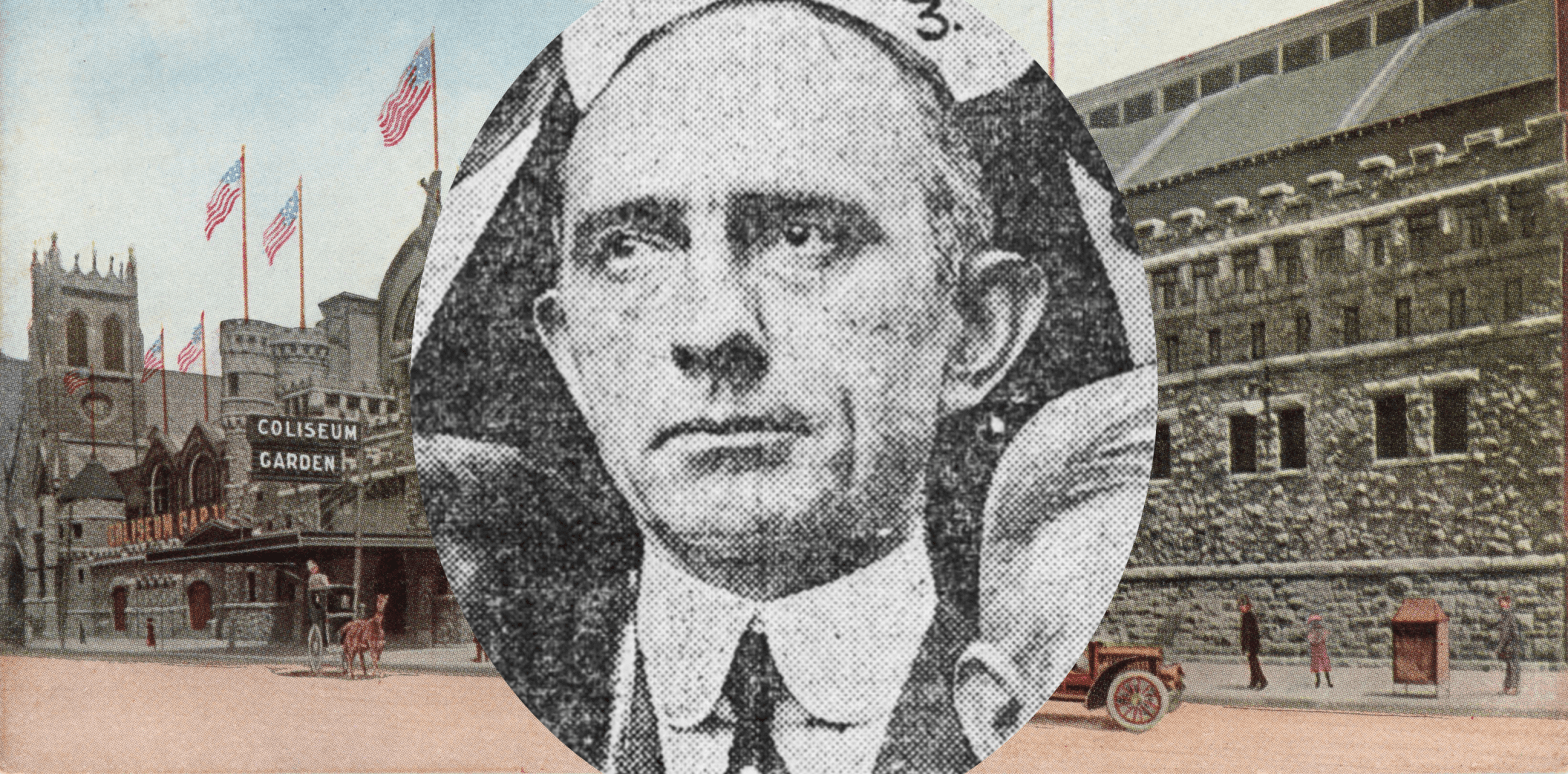
At about half-past five on September 29, 1912, the crowd gathered at the Marietta depot was more anxious than usual about the upcoming train. After the regularly scheduled passenger train, a second train arrived at the station with one of the most respected men in America. Theodore Roosevelt was returning to Chattanooga after speaking at Atlanta in the middle of his battle for a third term. That morning, he had visited the house where his mother grew up in nearby Roswell. At the depot, one man, known as “the Colonel’s most enthusiastic follower in these parts,” was “lifting the children up to shake the Ex-president’s hand.”[1] One can only imagine the glee as that “enthusiastic follower,” C. C. Coyle, met the former president.
C. C. Coyle lived a long and eventful life, stretching from the end of Reconstruction to the start of World War II. Devoted to his political principles, he stood out as a black sheep amongst his neighbors. The breadth of his activity, from his time as a “feather renovator” to his political life to enforcing prohibition, has never fully been explored but offers a unique lens through which to look at this era of Georgia’s history.
Origins
Culloden Centennial Coyle was born December 12, 1876, in Kentucky. Why his parents chose the name Culloden is a mystery. The name Centennial is much more obvious, given that Coyle was born as the nation’s 100th-anniversary celebrations were coming to a close. His parents were Judge Thomas and Mary Young Coyle, who evidently loved alliterative names. Young Culloden had an older brother named Carlos Cortez, an older sister named Cleopatra Cornelia, and a younger sister named China Corene. Two more younger siblings shared the same name as their parents.[2] Carlos, a folk artist, would become the family’s best-known member.[3]
The Coyle family was deeply Republican in an era when Democratic hegemony in the South – Known as the Solid South – was emerging. After Reconstruction, former Confederate states repudiated the Republican Party almost completely, and Democratic control would be the norm until the 1960s. Kentucky, which did not join the Confederacy, would become largely Democratic but not entirely to the same extent as other Southern states. The Coyle family politics could be found in a glance at the family tree. Judge Coyle had one sibling named for Abraham Lincoln and another named for abolitionist Cassius Marcellus Clay.[4] Judge Coyle himself ran for office as a Republican.
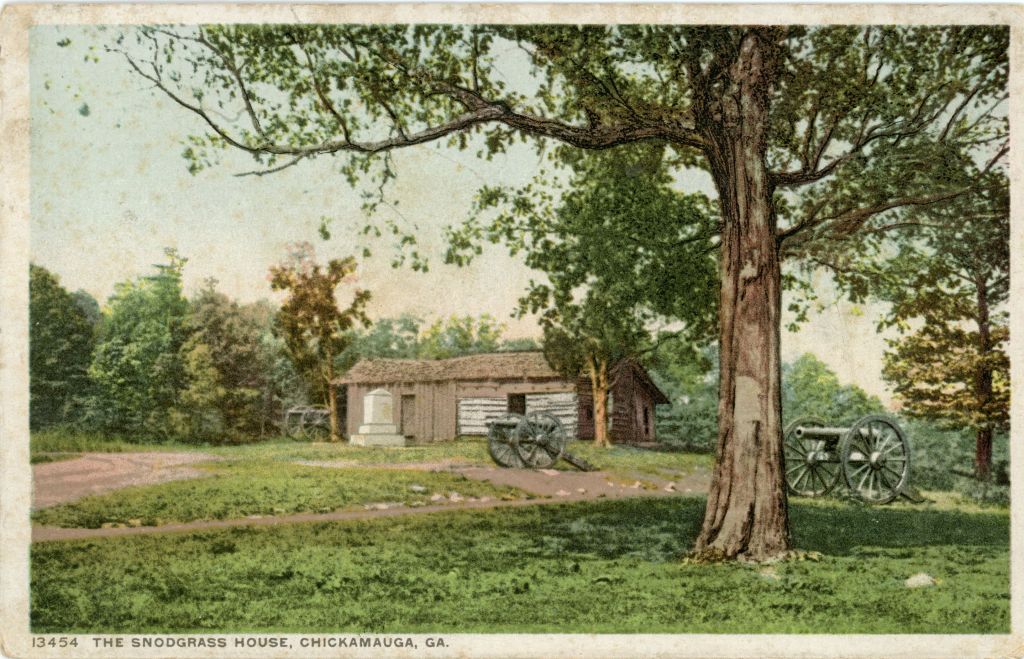
The early life of C. C. Coyle is hard to pin down, partly because of his siblings’ similar initials. During the Spanish-American War, he served in the 160th Indiana Regiment. In May 1898, the 160th was sent to Camp Thomas in Georgia to train. It was on the site of the Battle of Chickamauga, the bloodiest Civil War battle in the state. In a letter by Coyle published by the Elwood Daily Record, he described walking across the park preserving the battlefield, saying it was “almost a sold mass of monuments and towers.”[5] Before the 160th was sent to Cuba, Coyle was transferred to the hospital corps to work as a stenographer. He worked at a hospital in his home state of Kentucky. In February 1899, a C. C. Coyle (possibly the same) was working at the hospital of Atlanta’s Fort McPherson.
Coyle moved back to Kentucky briefly, as in the 1900 census, he can be found working as a “feather renovator” – someone who prepared feathers for mattresses and pillows. In 1902, he was working as a feather renovator in Marietta.[6] It was there that he met Clara Mae Barrett, and they married in 1903. The Coyles would have eight children. Clara Coyle and her father-in-law apparently had a difficult relationship. In 1917, Judge Coyle wrote C. C. out of his will, saying it was because of “Cull’s wife calling me a CountrY [sic] sager at Leesburg.”[7]
Hoke Smith
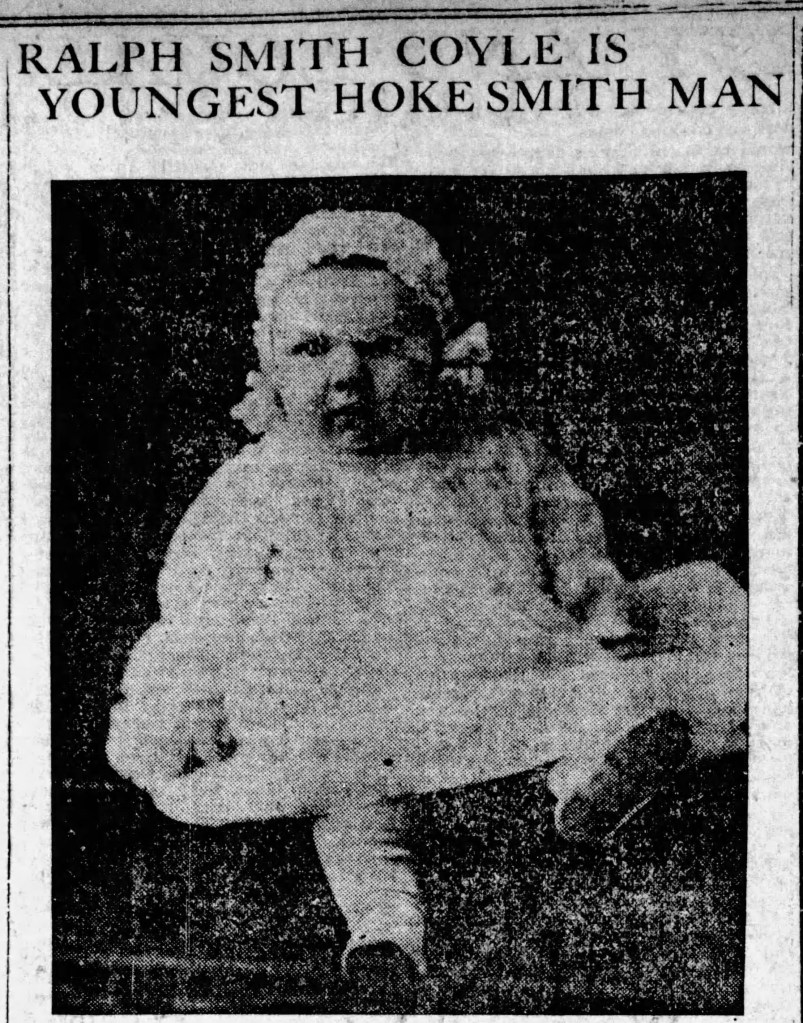
In 1905, Coyle was the circulating manager for the Jacksonville Sun. Within a few years, he had returned to Georgia, working as a traveling salesman. He quickly became involved in politics as a strong supporter of progressive governor Hoke Smith.[8] By 1908, he was listed among the “well known and active Hoke Smith supporters” by an Atlanta Journal correspondent who attended a rally in Rome.[9] When a Coyle son was born in 1908, he initially considered naming the child after Hoke Smith. Ultimately, he chose the name Ralph Smith in honor of the Journal’s Washington correspondent who covered the Hoke Smith campaign. When Ralph was eight months old, the Journal printed his photo under the caption “Ralph Smith Coyle is Youngest Hoke Smith Man.”
Smith, like most of the South, was a Democrat. Though Coyle’s party switch from Smith to Roosevelt’s Republicans may seem drastic, both Smith and Roosevelt belonged to the Progressive movement. Gubernatorial historian James F. Cook described Hoke Smith as “Georgia’s most outstanding progressive,” though perhaps his most important legacy was the disfranchisement of African American voters across the state.[10] Coyle did not shy away from the Republicanism of his father, attending an Atlanta banquet honoring Roosevelt’s chosen successor, William Howard Taft, in 1909. Taft and Smith were both speakers, and it is tempting to think that Coyle met both at the dinner.
Starting in early 1909, Coyle worked as a traveling representative of the Atlanta Journal. He would serve in this role until the 1920s, except for a brief period selling pianos. He was well respected in the traveling salesman community, as he served on the executive board of the Georgia Travelers Association. He was also one of several salesmen who presented Hoke Smith with a cane in 1909.
In 1910, Marietta’s postmaster resigned, and Coyle applied to fill the vacancy. Postmaster appointments were the most visible sign of political patronage in the country, and since the Civil War, Republican presidents had selected prominent Republicans for these jobs in the South. The fact that Coyle applied is a strong indication of his politics.
Bull Moose
Between the Civil War and the Great Depression, the 1912 election cycle was among the most important in American history. Back in 1908, Theodore Roosevelt supported William Howard Taft, and Taft was easily elected. In the four years since then, Roosevelt had soured on Taft and decided to run for an unprecedented third term. Early in that year, C. C. Coyle was president of his local Roosevelt club and was sent to the Georgia Republican statewide convention alongside several other men, black and white. Additionally, he and A. T. Atwater, a Black resident of Rome, were selected as district delegates to the Republican National Convention in Chicago.

At the Chicago convention, chaos reigned. Competing delegates from different states vied to be recognized as the legitimate nominees. Ultimately, the Taft delegates prevailed, and he was nominated. Roosevelt’s supporters vowed to continue the fight, creating a new Progressive Party for Roosevelt. Coyle was disappointed but “returned from Chicago… confident that Col. Roosevelt, the knight of the shining teeth, will be our next president.”[11]
Coyle was quick to join the new Progressive Party, soon dubbed the Bull Moose Party in honor of its standard bearer. Soon, two competing organizations emerged. St. Julien Yates of Atlanta led the “Roosevelt Georgia White League,” which promised to be a whites-only Progressive party. Coyle joined a competing organization led by Roger A. Dewar that initially promised to allow Black delegates but soon reneged. The two groups met on the same day, at the same Atlanta hotel, in adjoining ballrooms.[12] Both had famous supporters. Yates’ group included Rebecca Latimer Felton and Helen Dortch Longstreet, two of the most important women in Georgia politics, while Dewar’s group included a son of Henry Grady and a son of Joel Chandler Harris. Neither group selected Coyle to be a delegate to the national convention. Georgia was not alone in having two competing organizations, one all-white and one with Black membership. Due to Roosevelt’s influence, the national committee would reject all Black delegates from the South when it met in August 1912. In Georgia, the situation was a bit reversed, as the Dewar faction, formerly in favor of Black delegates, was seated at the convention.
Just after the Progressive National Convention, Coyle traveled to Oyster Bay to meet Roosevelt. The two met at Roosevelt’s Sagamore Hill. Coyle hoped to convince Roosevelt to make a speech in Marietta but was apparently unsuccessful. Sadly, no more details about their meeting exist. Roosevelt did come to Georgia in September to speak in Atlanta, and Coyle was in charge of distributing seats to Roosevelt supporters in his district. Just after the speech, Roosevelt’s train passed through Marietta.[13]
On election day, Roosevelt was defeated. By splitting the Republican vote between Taft and Roosevelt, defeat was practically guaranteed. Woodrow Wilson, a New Jersey governor raised in Georgia, was elected. Roosevelt’s popularity was not enough to secure victory in Solid South Georgia, and he received about 18% of the state’s vote compared to Wilson’s 76%. Taft received less than 5%.
The Wilson Era
Though the Progressive Campaign ended in defeat in 1912, it took a few years for the new third party to vanish. In 1914, during the Gubernatorial elections, the Progressive Party in Georgia fell into disarray, and as part of the advisory committee, Coyle had a front-row seat. Many in the party were inclined to nominate Fulton County attorney Hugh Dorsey for governor, but ultimately no nomination was made. Coyle went in a different direction, endorsing Dr. Lamartine Griffin Hardman. Neither candidate won, though both would later serve as governor. That same year, Roosevelt returned to Atlanta and, during his ten minutes in town, met with several party notables, including Coyle.[14]
One of the darkest, most shadowy moments in Coyle’s life seems to have come in 1915. Two years before, factory worker Mary Phagan was killed, and her boss, Jewish factory superintendent Leo Frank, was soon convicted in the court of public opinion as the culprit.[15] Frank was convicted and sentenced to death, but Governor John M. Slaton commuted his sentence to life in jail in August 1915. Outraged, prominent citizens of Marietta organized a mob, drove to the state prison in Milledgeville, kidnapped Frank, brought him to Marietta, and lynched him just outside of town.
The following month, the grand jury of Cobb County was charged to investigate the lynching. Over two dozen witnesses were called, including county notables, reporters, and C. C. Coyle. It is unknown if Coyle witnessed Frank’s hanging, but many of the witnesses called were present on the dreadful night. Coyle’s role, shrouded in secrecy, is a part of his life made more uncomfortable by its mystery.
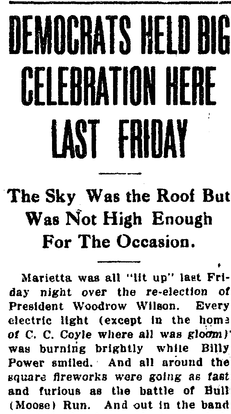
During the 1916 election season, Coyle was part of the last statewide Progressive Party convention. Roosevelt refused to run as a Bull Moose, and Coyle may have switched his allegiance to the Republicans. He was in Chicago at the same time as the Republican National Convention. That year, Wilson secured a second term, leading to rejoicing in Marietta. According to the front page of the Marietta paper, “Every electric light (except in the home of C. C. Coyle where all was gloom) was burning brightly.”[16]
The US entry into World War I came with fresh opportunities for Coyle. At Camp Gordon near Augusta, he became the official representative for all Atlanta newspapers. In this role, he got to see doughboys train firsthand. He had “a battalion of newsboys for whom he has mapped out a schedule of intensive training… Mr. Coyle is proving an able field marshal.”[17] His family would live in Marietta throughout the war, and Coyle returned home at its close.
Prohibition
The years 1919 and 1920 brought two significant national changes that impacted Coyle. The first was the ratification of the Eighteenth Amendment in 1919, and the second was the election of Republican Warren G. Harding in 1920. After his election, Harding sought to rebuild the Republican party in the South and used Georgia as the first step towards creating a two-party system. As leader of the party, Harding was able to demolish the existing Republican structure and replace it with a “lily white” organization.[18] Coyle was invited to be a part of the reorganization, though it was not all white as was expected. In late 1921 or early 1922, he was elected executive secretary.

Because of its controversial beginnings, the new Georgia GOP faced heavy obstacles. In early 1922, accusations emerged of bribery and patronage in the party, dividing the party further. In his role as executive secretary, Coyle would serve as a public face of the party, working to salvage its reputation and that of its chairman, J. Louis Phillips. Following the 1922 elections, the Georgia GOP essentially lost Harding’s support, and within months after the president’s death in 1923, the old guard of the party returned to lead. By then, Coyle had left the statewide organization to work for the post office.
In February 1924, Coyle was sworn in as a Deputy Collector of Internal Revenue and was placed in charge of prohibition enforcement in Cobb, Cherokee, Forsyth, Milton, Polk, Paulding, Haralson, Douglas, and Bartow counties. Working out of Marietta’s post office, Coyle coordinated the hunt for moonshine across the county. In his first week, he destroyed “eight stills, 170 gallons of whiskey, and 2500 gallons of beer.”[19]
Over the next year, Coyle would be involved in many prohibition escapades. The Dixie Highway, a major alcohol thoroughfare, passed through his jurisdiction. In one June 1924 incident, he was involved in a seventy-mile car chase across North Georgia, hunting down a car with 120 gallons of liquor. That same week, he destroyed a still with 3000 gallons of beer. Another week in August saw 4000 gallons of beer destroyed.
In October, his prohibition career came to an end with his arrest. According to the warrant, Coyle accepted a $20 bribe from the “king of the moonshiners,” John Henry Harbin. Coyle told reporters he was framed.[20] At the trial in November, Hardin testified that he had paid Coyle the money “to catch ‘stillers in my community” rather than encouraging Coyle to turn a blind eye. Coyle’s case was dismissed, and he was exonerated. Hardin, meanwhile, went to court for perjury in his initial statements incriminating Coyle. He did not return to his original position and instead became a special field deputy for Marshal Walter Akerman in early 1925. How long Coyle served in this role is unknown.
Later Years
After 1925, Coyle’s name became more infrequent in newspapers than earlier in the decade. By 1930, he had switched careers entirely, becoming a real estate broker in Marietta. He continued to stay involved in Republican politics, serving as a delegate to the state convention in 1932 and secretary of the Cobb County GOP in 1936. In the middle of 1941, he contracted an unspecified illness, and he passed away on September 11, 1941. His death made the front page of the Marietta Journal. He was laid to rest in the Marietta City Cemetery, where his wife Clara would join him in 1962. The party Coyle championed would not gain prominent electoral power in Georgia until decades after his death. While he lived in an era dominated by a single political party, his life serves as a case study of the role of opposition to the Solid South.
[1] October 4, 1912 Marietta Journal and Courier
[2] https://www.findagrave.com/memorial/79521728/culloden-centennial-coyle
[3] For more information, see “Themes in the Works of Carlos C. Coyle” by Patti M. Marxsen, The Clarion (Winter 1986/87).
[4] https://www.findagrave.com/memorial/8298078/thomas_james_coyle
[5] July 6, 1898, Elwood Daily Record
[6] December 11, 1902, Marietta Journal
[7] Will of T. J. Coyle dated March 17, 1917, Jackson County, Kentucky.
[8] For a biography of Smith, see Hoke Smith and the Politics of the New South by Dewey W. Grantham, Jr. (Louisiana State University Press, 1958).
[9] May 26, 1908 Atlanta Journal
[10] The Governors of Georgia 1754-2004, Third edition, revised and expanded by James F. Cook (Mercer University Press, 2005)
[11] June 28, 1912 Marietta Journal and Courier
[12] The story of the competing conventions is covered in “The 1912 Progressive Campaign in Georgia” by William F. Mugleston (Georgia Historical Quarterly, Vol. 61, No. 3).
[13] October 4, 1912 Marietta Journal and Courier
[14] September 7, 1914 Atlanta Journal
[15] For more info, see And the Dead Shall Rise: The Murder of Mary Phagan and the Lynching of Leo Frank by Steve Oney (Vintage Books, 2004)
[16] November 17, 1916, Marietta Journal and Courier
[17] October 18, 1917, Atlanta Journal
[18] For more info, see “‘”The Georgia Experiment’: President Warren G. Harding’s Attempt to Reorganize the Republican Party in Georgia” by Robert E. Hauser (Georgia Historical Quarterly, Vol. 62, No. 4)
[19] February 21, 1924, Marietta Journal
[20] October 25, 1924 Atlanta Journal.
Interested in subscribing to my blog? Type your email below to be notified about new posts.
 Andrew J. Bramlett