
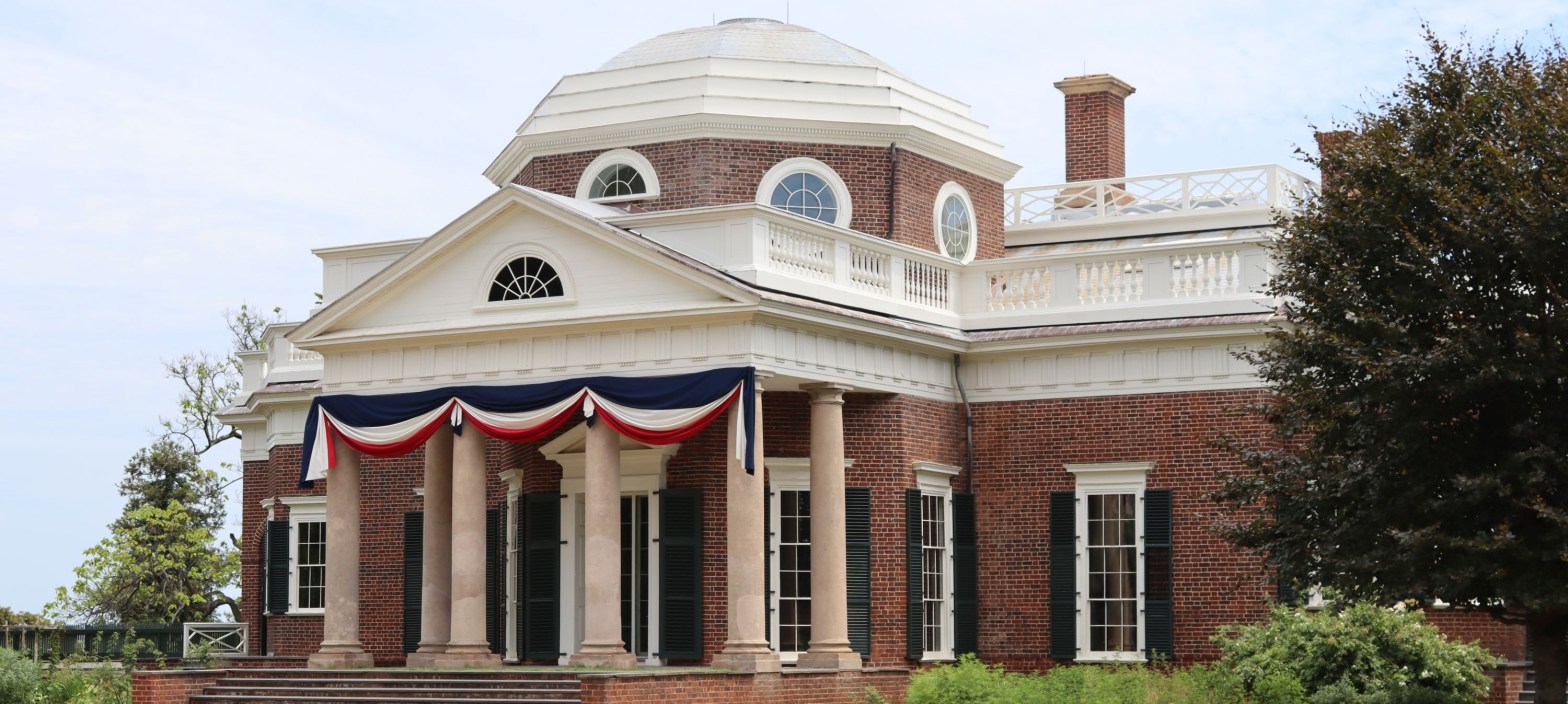
Just after the Fourth of July this year, I visited Virginia to attend Rare Book School. My mom and I saw Jefferson’s famed home, Monticello, and spent a week on the campus of his beloved University of Virginia. We finished the week at his retreat home, Poplar Forest. (Photos of these sites can be found here). Seeing these sites and being surrounded by Jefferson’s legacy has given me a better understanding of his life and of Jefferson’s America, but many questions still linger.
Part 1: Who was Thomas Jefferson?
Jefferson is a figure hallowed by many and equally derided by others. He played a crucial role in founding the United States and helped provide the Enlightenment philosophy behind the American Revolution. He was a luminary, statesman, author, inventor, connoisseur, architect, and so the list continues. The same freedoms he espoused in the Declaration of Independence he denied to those enslaved by him, which is especially prominent in his longtime relationship with Sally Hemmings. The focus of much attention recently, Sally Hemmings has become a crucial part of Jefferson’s story since the 1990s.
I like to read presidential biographies, especially those of significant presidents, yet Jefferson has always vexed me. Being so influential in politics and such a divisive figure today, I did not know where to start reading about his complex life. Before preparing for my trip, I had only read two books focused on Jefferson. The first, A Magnificent Catastrophe: The Tumultuous Election of 1800, America’s First Presidential Campaign by Edward J. Larson, focuses on Jefferson’s relationship with John Adams and the election of 1800. A crucial part of this book is the vitriol in that year’s election. Jefferson (while notably magnanimous in his inaugural address) seems to have not always been above the fray during the election campaign. His opponent, longtime political enemy and close friend John Adams, suffered a similar problem. The second book, The Lost World of Thomas Jefferson by Daniel J. Boorstin, is a detailed, fascinating look at the opinions of the Jeffersonians. It is densely packed with intellectual and philosophical ideas showing the impact of Jefferson on early American society. These two books, one on Jefferson’s political life and the other on his intellectual spirit served as my intro to his life.
When I found out about my trip, I decided to read a full biography of Jefferson but ran into the quandary of what to pick. Since so many biographies have been written, I did not know where to find a balanced, reasonably detailed account. In a moment of serendipity, I was given Jon Meacham’s Thomas Jefferson: The Art of Power while eating at a local Mexican restaurant.
The particular edition I was given is in large print, so the main text runs to almost 800 pages. In regular print, it is about 500. When I started reading the book, I figured this would allow for plenty of detail; upon finishing, I was stunned it did not. I do not mean to denigrate Meacham’s work here, as it is an excellent overview of Jefferson’s life. Even with its heft, it still seems to just scratch the story’s surface. To be cliché, it is the tip of the iceberg, with the rest of Jefferson unclear in the waters below. A man of such varied activity and complex opinions would require volumes to cover adequately. I finished Thomas Jefferson: The Art of Power while in Virginia, so I could read about Monticello within hours of walking its grounds. Being able to connect the action of the book with Charlottesville around me did help it seem more real.

Part 2: To the Little Mountain
From Charlottesville, Monticello is a short drive away. You drive under the interstate, make a left, and climb up a hill until a large stone bridge appears out of the landscape. If you go straight, you reach the James Monroe house; a right will take you on a ramp to the bridge and into the grounds of Monticello.
The visitor center is new and named after the great benefactor of American history, David M. Rubenstein. It is built around a courtyard, with a museum building on one end. Our visit started here. One gallery on the main floor focuses on the Declaration of Independence. It is simple: one end of the room has an 1823 printing, one wall has a quote about the document, and the opposite wall depicts its signing. Standing in the room, a voice reads the document, from its legendary preamble to its often-forgotten detailed criticisms. The gallery is simple, and its power is meant to derive not from information but from the Declaration.
Opposite this gallery is a room, in marked contrast, filled with artifacts, exhibit panels, and photographs about the making of Monticello. In this exhibit, the spirit of Jefferson can start to be seen laboring over plans, choosing paint colors, and pouring over architectural books of architectural designs. A gallery upstairs continues the theme of Jefferson the scientist, the architect, and the planner. That gallery adds another dimension, not the planner, but the planter. Monticello would not have been possible without enslaved laborers. The most impactful item here is a small cup that Sally Hemmings may have owned. Surrounded by many expensive artifacts from Jefferson, this solitary artifact is one of the few physical reminders left of a woman who lived at Monticello most of her life. Jefferson could afford countless trinkets and books; Hemmings likely purchased this tiny cup. The divide is immense.
The house reinforces this theme. Monticello was designed as a way for Jefferson to broadcast to the world his refinement and his America. The name is Italian for “little mountain.” It is based on Italian architecture and is filled with classical paintings. Fine wine played a significant role in Jefferson’s role as host at the house. Busts and paintings can be found of Enlightenment figures, some of whom Jefferson met. The Declaration of Independence is a recurring motif. Beneath the house’s wings, traces of the men and women Jefferson did not treat as “created equally” can be found. Kitchens, pantries, cellars, and more were the domain of the enslaved laborers at Monticello. They lived in a row of houses nearby called Mulberry Row. Jefferson had a private reading spot down the hill with fences to block the view of the houses of the enslaved. In contrast to the elaborate Monticello, the replica slave cabin is made of crude, roughhewn logs with a small cot.
The Jefferson who owned 600 enslaved people is difficult to reconcile with the Jefferson who wrote the Declaration of Independence. No matter what I have read or seen about Jefferson, I still cannot wrap my head around how this dichotomy could exist in the same person. He is an enigma, and at Monticello, this is on full display.
As difficult as understanding Jefferson can be, he also became much more human when visiting. It is easy to place the Founding Fathers on a pedestal and forget they led average lives. It was interesting to see how the same was true in Jefferson’s day. Visitors would arrive at the house unannounced, sometimes forty at a time, expecting a place to sleep and food to eat. Jefferson would not turn them away, but he built a quieter house in Lynchburg (Poplar Forest) to escape the throng several times a year. There is something humanizing about a man attempting to avoid being treated like a saint.
Touring the house is a reminder of Jefferson’s family life. In addition to the bedroom for Jefferson and his wife, there are bedrooms for children, grandchildren, his sister, and a son-in-law. A significant focus of our tour was his family, shedding light on how they were like anyone else. We saw the house’s nursery, examined the types of toys used by his grandsons, and heard about Jefferson’s granddaughter’s negative opinion of their great-aunt. Also spotlighted were Jefferson’s friendships. The Madisons frequently used a room in the front of the house, while a bust of John Adams sat inside Jefferson’s office. Seeing more of Jefferson beyond biographical facts (…Jefferson was president from 1801 to 1809, a time which saw great change in the fledging nation. His cabinet was composed of…) made it easier to see him as an individual.
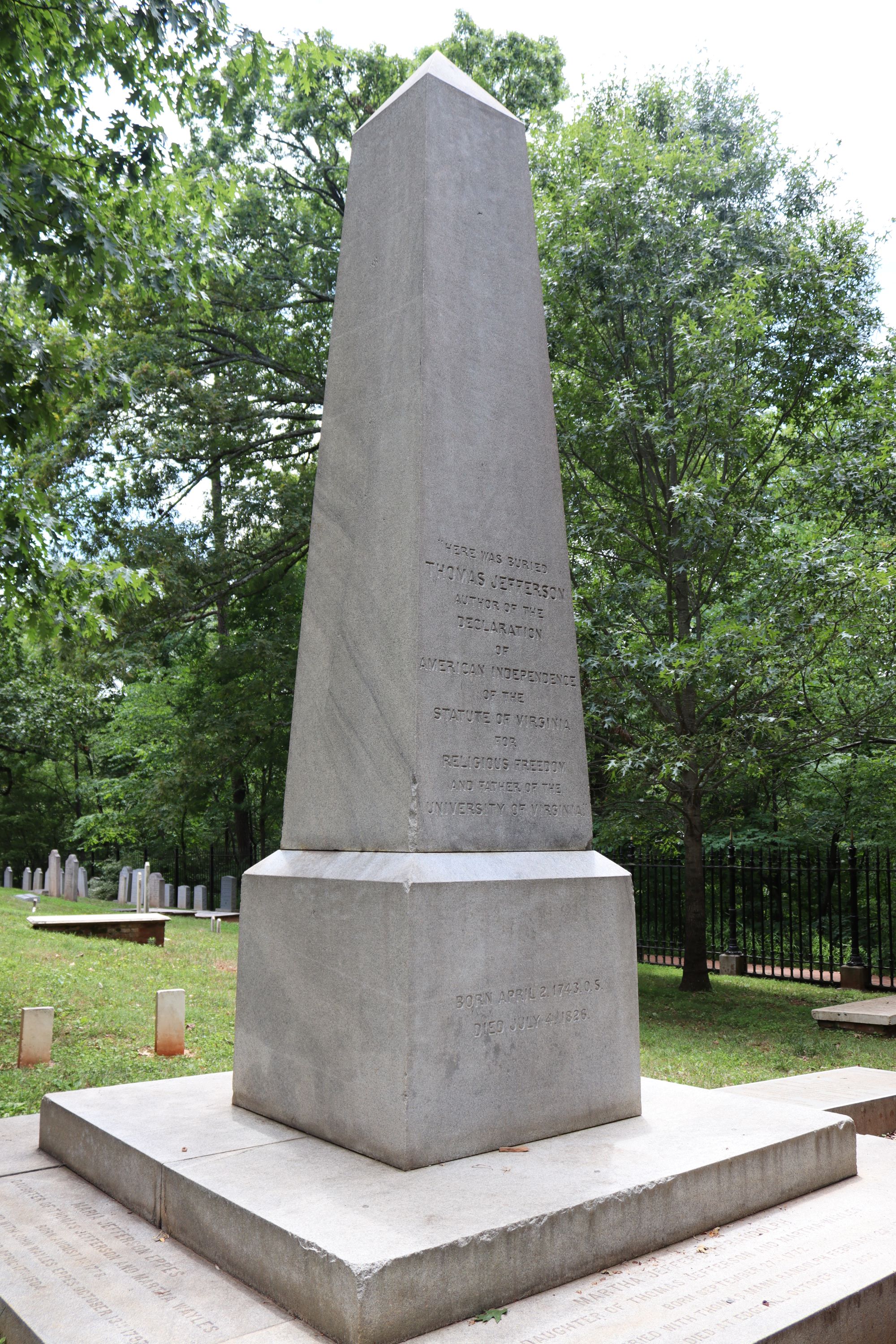
Monticello is a fascinating home. It shows how he would have seen the house after his presidency and until his death. Standing in the room where he died fifty years to the day after July 4, 1776, is a special feeling. I would recommend the house to anyone interested in American history, regardless of whether or not they like Jefferson. It offers something for all differences of opinion about the third president.

Interlude: Shrine to the Nation
One more story from Monticello deserves to be shared. Thomas Jefferson died at Monticello in 1826, and the house was purchased for use as a museum in 1923. What happened in between? Glimpses can be seen on the grounds at Monticello, including the grave of a past owner’s mother. The whole story can be found in Saving Monticello: The Levy Family’s Epic Quest to Rescue the House that Jefferson Built by Marc Leepson, available for sale at the Monticello gift shop. I highly recommend this book for those interested in presidential or house history.
If Jefferson is a hallowed president, Monticello is a hallowed house. The visitors who flocked to the house during Jefferson’s life did not stop coming after his death. For most of the period between 1826 and 1923, it was owned by the Levy family. The first Levy owner, Uriah Levy, was the first Jewish American commodore of the US Navy. He was a descendant of Dr. Samuel Nunez, one of the first settlers of Georgia. A relative of Uriah, Jefferson Monroe Levy, owned the house when it was sold in 1923. Both members of the Levy family were fans of Thomas Jefferson. It was a significant factor, if not the only reason, for Uriah Levy to buy the house. In Saving Monticello, they are presented as good stewards of the home, and this assessment seems accurate. Throughout the tour, our tour guide pointed out how so much of the house is original. This is, in no small part, thanks to the Levy family.
Where the story gets complicated is the effort to make Monticello a national shrine. Accusations emerged in the early 1900s that the Levys hated Jefferson, had defaced his house, and resented the attention it was given. A national effort began to take the home from the Levys and give it to the nation. There are very many antisemitic undertones to accusations made against both Levys. Jefferson Levy eventually sold the house, but he made it clear to the world that it was on his terms. In the end, both sides won the fight. Monticello itself also emerged victorious from this story; thanks to the Levys and the current non-profit owner, it has been in caring hands for almost the entire time since Jefferson’s death.
While touring Monticello can show the human side of Jefferson, the story of the Levys “humanizes” the home. While it is presented as “Jefferson would have seen it,” time did not stop with his death. The story of the house shows how national shrines are created and usually do not evolve naturally.

Part 3: At Mr. Jefferson’s University
My first view of the University of Virginia (UVA) came from Monticello. If you look closely enough, a small white spot in the landscape appears through the trees. It is the Rotunda, the heart of Jefferson’s original campus and one of the most important academic buildings in the nation.
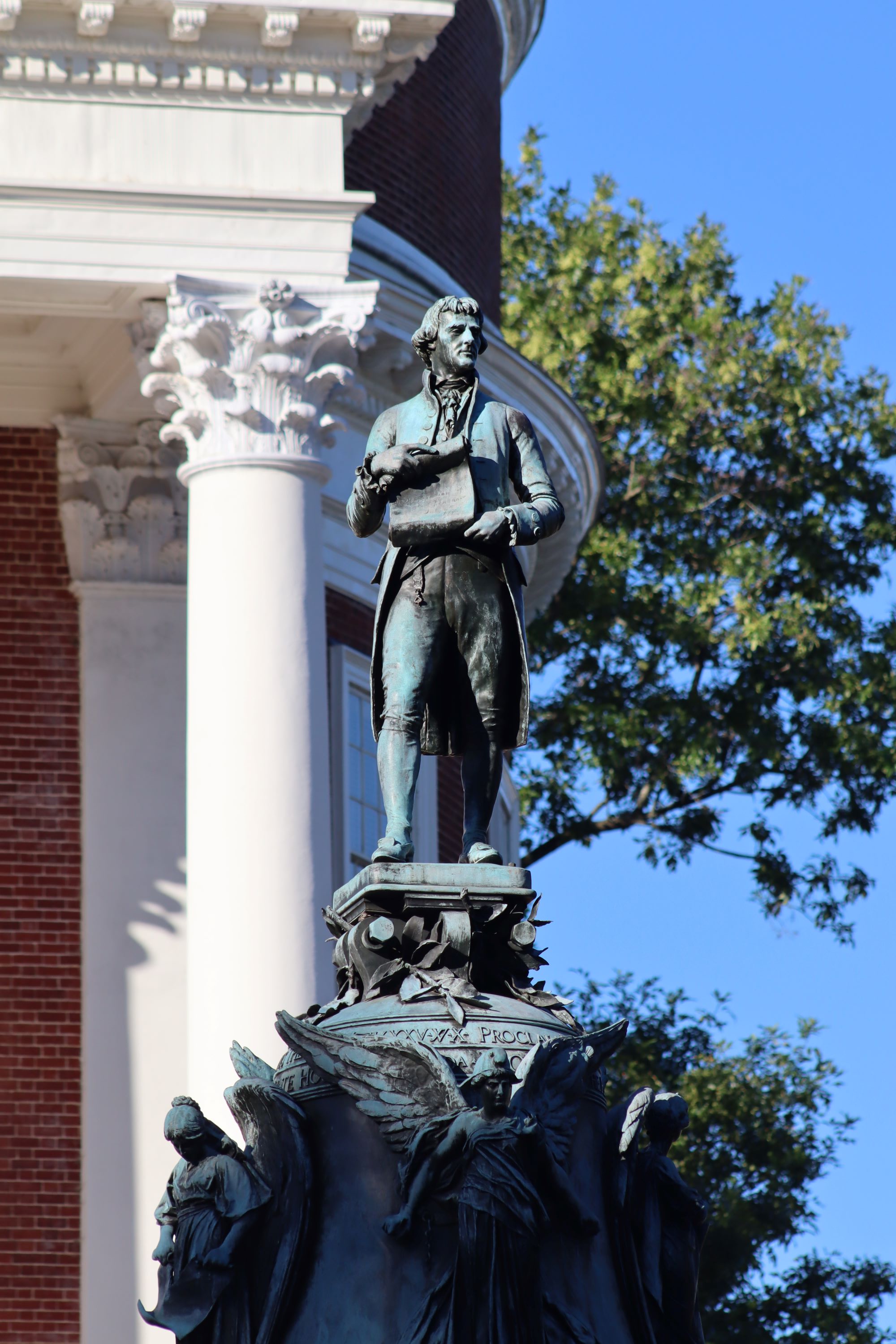
Two of my grandparents went to UVA, and remember how, even into the 1960s, it was called “Mr. Jefferson’s University,” as if, at any moment, he would appear from behind a column and host a pop quiz. While I was not on campus long enough to uncover if it is still colloquially “Mr. Jefferson’s University,” he is still present. From University Avenue, looking towards the Rotunda, there is a large statue of Jefferson standing atop the Liberty Bell with the Declaration of Independence in hand. Inside the Rotunda is another statue of Jefferson. At the end of the lawn, statues of Jefferson and Washington stand opposite each other. The buildings themselves are Jeffersonian, reflecting his unwavering belief in classical architecture.
The Rotunda has been faithfully restored to its original appearance. Like the other sites I visited on this trip, there is a reason restoration has been needed. In 1895, a massive blaze gutted the building, and it was not rebuilt to its pre-fire design. In the 1970s, it was brought back to how “Jefferson would have seen it,” followed by another update with a similar goal from 2014 to 2016. Inside the dome room, the wood floor felt new, the columns looked recently painted, and the space was bright and airy. Its freshness is closer to how it would have looked in Jefferson’s day, but it also gives a modern feel. Where Monticello was primarily kept intact by the Levys and has looked relatively the same since the 1950s, the restoration here is much younger. At Monticello, there is still a feeling of age and heritage. At the Rotunda, it feels new and fresh. Both attempt to show an original state but bring about very different reactions.
When laying out the university, the aging Jefferson wanted reason at its heart. The Rotunda overlooks the entire original campus and serves as the school library. By tradition, this central location should have been a chapel, yet a Jeffersonian ideal prevailed here. Through fire and renovation, the Rotunda continues to serve as a university landmark. Close to the Rotunda is a chapel, a much smaller building built in the Gilded Age. It is a beautiful building, but its Richardson Romanesque design, evoking a Medieval church, feels out of place amidst buildings of classical columns and symmetry.
The campus’s main lawn is a reminder of the school’s constant change and historic traditions. The buildings have been used as dorms since the 1820s and are still used by students today. It, too, feels unchanged since the school’s founding, but the buildings surrounding it become gradually newer. Each is designed (with the notable exception of the chapel) to blend seamlessly into the neoclassical campus.
It is fair to say that a part of Jefferson’s spirit lives on at UVA. There are reminders of the darker sides of his life, like a Memorial to Enslaved Laborers, but his nobler traits are also exhibited here. It is a place of learning, culture, and scholarship, pillars of the Jeffersonian ideal. All that being said, the school does not need to stay in Jefferson’s day for his spirit to be felt. UVA can remember its founder without being burdened with his faults as it changes and evolves. The idea of “Mr. Jefferson’s University” is nice, but he does not need to be seemingly waiting around every corner to have an impact. So long as the campus is devoted to scholarship, his legacy of education lives on. The Jefferson seen here is less an individual, but an idea.
Part 4: Retreat in the Wilderness
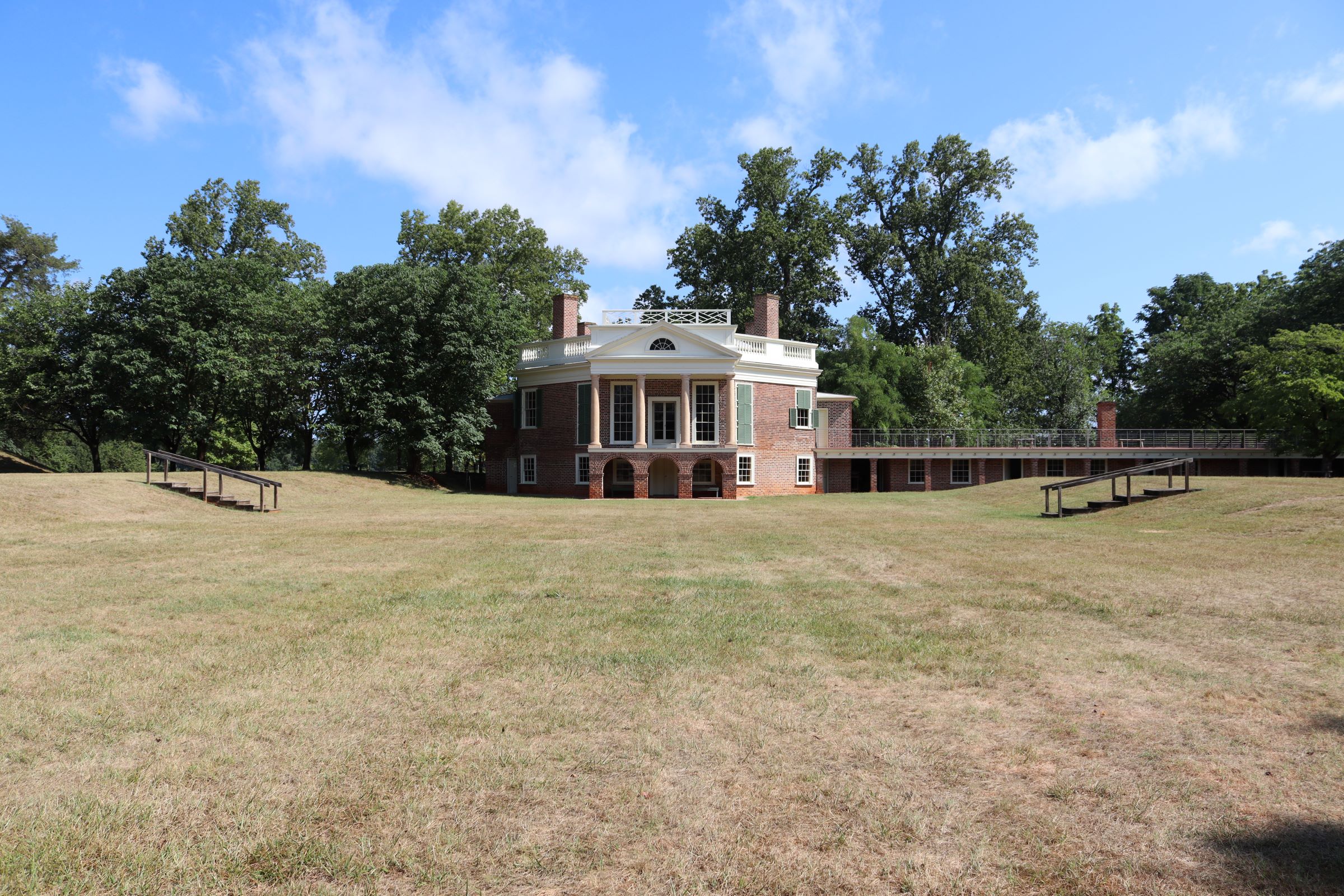
The last Jefferson site we visited was Poplar Forest. While Monticello and Charlottesville are both landmarks of Charlottesville, Poplar Forest is about an hour and a half away in Lynchburg. This was Jefferson’s retreat, a home to get away from the chaos of Monticello.
The plantation at Poplar Forest first significantly entered Jefferson’s life during the Revolution, when his family fled British soldiers at Monticello and hid at the Poplar Forest plantation. In 1806, during Jefferson’s presidency, construction on the house began as work at Monticello ended. It is a surprisingly small home, built with the proportions of an Italian villa. Several times throughout the year, Jefferson and two granddaughters would travel to Poplar Forest to escape Charlottesville.
On the tour of Monticello, the house was presented as a relic, a surviving piece of Jefferson’s time. Despite occasional references to updates (like air conditioning), the emphasis was still on the original. At Poplar Forest, the opposite was true. In 1845, the interior was gutted by a fire. After the house was purchased by a non-profit in the 1980s, the house was gutted again, this time intentionally. In the 1980s, nothing was left of the interior from Jefferson’s day, so the home was stripped bare so rebuilding could begin. Half of the house is now finished with plaster, while two whole rooms are stripped to the bare brick. This is not a negative, as it gives a much better sense of how the house’s interior is constructed. Most of what Jefferson would have seen during his time at Poplar Forest was construction, so it is another form of a site “how Jefferson would have seen it.” It also added another dimension to the house’s history, showing how it is not unchanging and impervious.
Like at Monticello, slavery played a significant role at Poplar Forest. At the site of the enslaved workers’ cabins is a frame representing the size of a cabin. Because of area development, it is sandwiched between two houses at the end of a cul-de-sac. From the house, I could easily see the RV parked next door. It is another reminder of changing landscapes and emphasizes how enslaved stories are often forgotten.
Poplar Forest is the least known of the places I visited, but its caretakers have the most unique approach to presenting the story of a Jefferson site. Notably, the emphasis is placed not on Thomas Jefferson as a whole but on Jefferson at Poplar Forest. Other places (like Monticello) have information on Jefferson’s full life, but by distilling the story down to his time at Poplar Forest, a small microcosm of his world is highlighted. Because the home was built mainly after his presidency, it is a world after the apex of his importance but the height of his celebrity. At Poplar Forest, he wished to escape his fame, and here he succeeded.
Parting Thoughts
Thomas Jefferson famously believed the Constitution should be rewritten every twenty years so that each generation could have a document that suited itself. He believed in a world continuously changing from generation to generation, and the sites visited reflect this. Monticello has changed the least. Preserved by the Levy family, it has become a national shrine, so beloved that it appears on the nickel. On the other hand, the Rotunda and Poplar Forest have changed immensely. While stewards of the Rotunda have sought to bring it back to Jefferson’s day, those of Poplar Forest are very upfront about the home’s change while not sacrificing its Jeffersonian restoration. They are very different approaches to historic preservation, each equally interesting and creating a unique feel at these historic sites.
When planning to make a Jefferson pilgrimage, I hoped to learn to appreciate better an individual I do not understand. The lightbulb “aha!” moment I was hoping for—where his life, politics, and philosophy would suddenly make sense—never came. After visiting these sites, I also understand better why it never will. He could have very strong opinions, but he was indecisive on the questions that vexed him. I have not abandoned my hopes of wrapping my head around Jefferson. My intention is the opposite, as I purchased several books about his life on the trip, which I hope will shed more light on his story. Balancing his good and bad touches on human nature and the foundational story of America in a way unlike any other figure of his time. After traveling to Virginia, Jefferson is still a mystery, but I think he is an enigma worth studying.
Interested in subscribing to my blog? Type your email below to be notified about new posts.
 Andrew J. Bramlett
2 thoughts on “Finding Thomas Jefferson”
Comments are closed.